Trafica and Nightwatch
Engines, Wednesday 23 September 2026
Recorded on a 360 camera in Meaford with a microphone on the hat. At 15:12 the question was put plainly: determine what engine it is, give a top three with a confidence on each, and let Nightwatch supply the hum and the levels. At 15:35 the two were asked to share one page. This is that page.
Nightwatch's half: the levels
Clip 019, from 15:28:40, 216 seconds. Nightwatch measured the level and the low end every half second and found four smooth, bass heavy swells. It measures sounds and does not name what made them, so it left them as engine or wind.
No engine lines anywhere in it. Wind or handling on the hat microphone.
A car's engine is audible from 0:46 to 1:25 and it is in frame, driving away, at 1:18. The last two swells also cover the walker running from the trail to the road, so they are engine and wind together.
Trafica's half: which kind of engine
An engine's sound sits on multiples of its crank speed. Which of those lines are strongest depends on how many cylinders fire per turn: a four fires twice per turn, a six three times, a V8 four times. So the spacing of the lines gives the revs, and the pattern of strong and weak lines gives the layout.
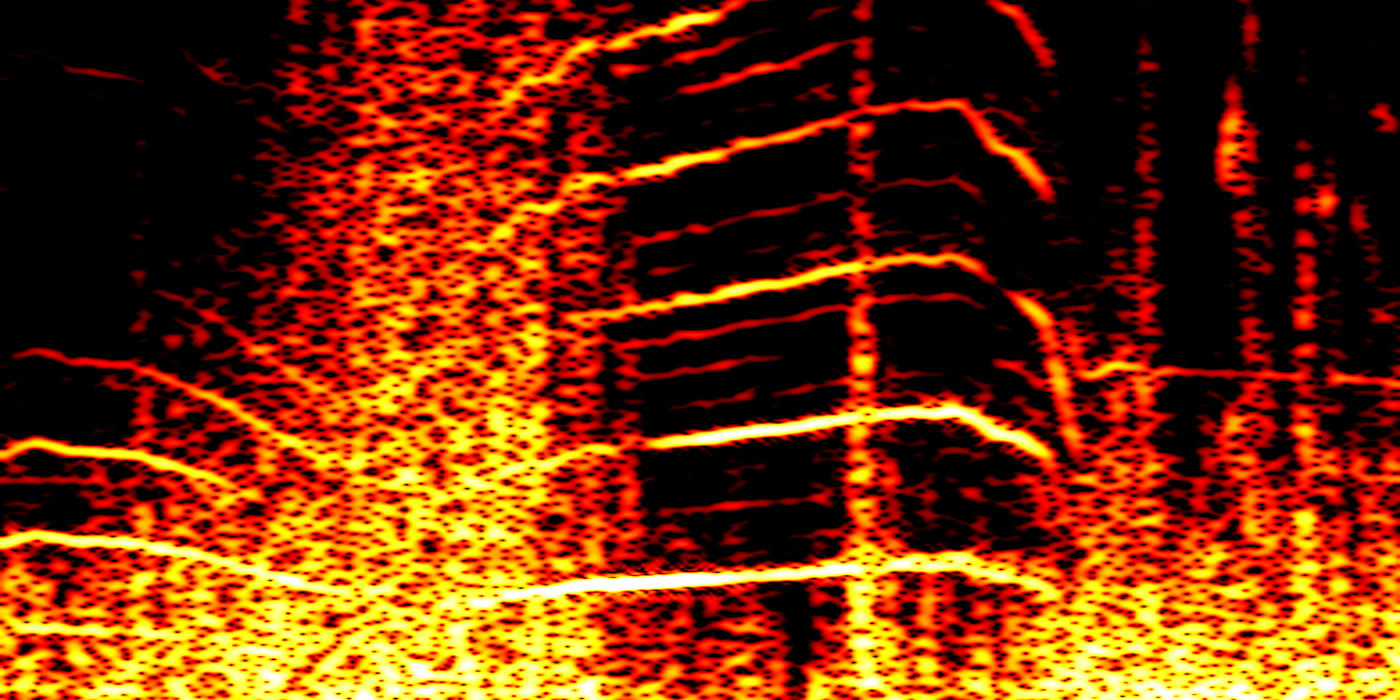
The car on the road, clip 019, 15:29:57 to 15:30:04
 60 Hz120 Hz180 Hz240 Hz300 Hz1:101:121:141:161:181:201:221:241:261:281:30
Slowing from 1:12, then pulling away from 1:17 to 1:23. At 1:20 the lines sit on every multiple of 35.3 Hz: 70.6, 106.7, 141.6, 177.0, 212.2, 247.8, 282.7, 318.4 and 352.8 Hz. The even ones stand 8 to 20 dB above the odd ones beside them. That puts the crank at about 2,100 rpm, rising to 2,300.
- 1Four cylinder80%
A four fires twice per turn, so its lines at two, four, six, eight and ten times the crank speed dominate. That is the pattern here.
- 2Three cylinder10%
There are a few in-between lines a three makes, but its main line, near 53 Hz, is missing.
- 3V85%
A V8 would make the 141 and 283 Hz lines stand out from the rest. Here 70, 212 and 353 Hz are just as strong.
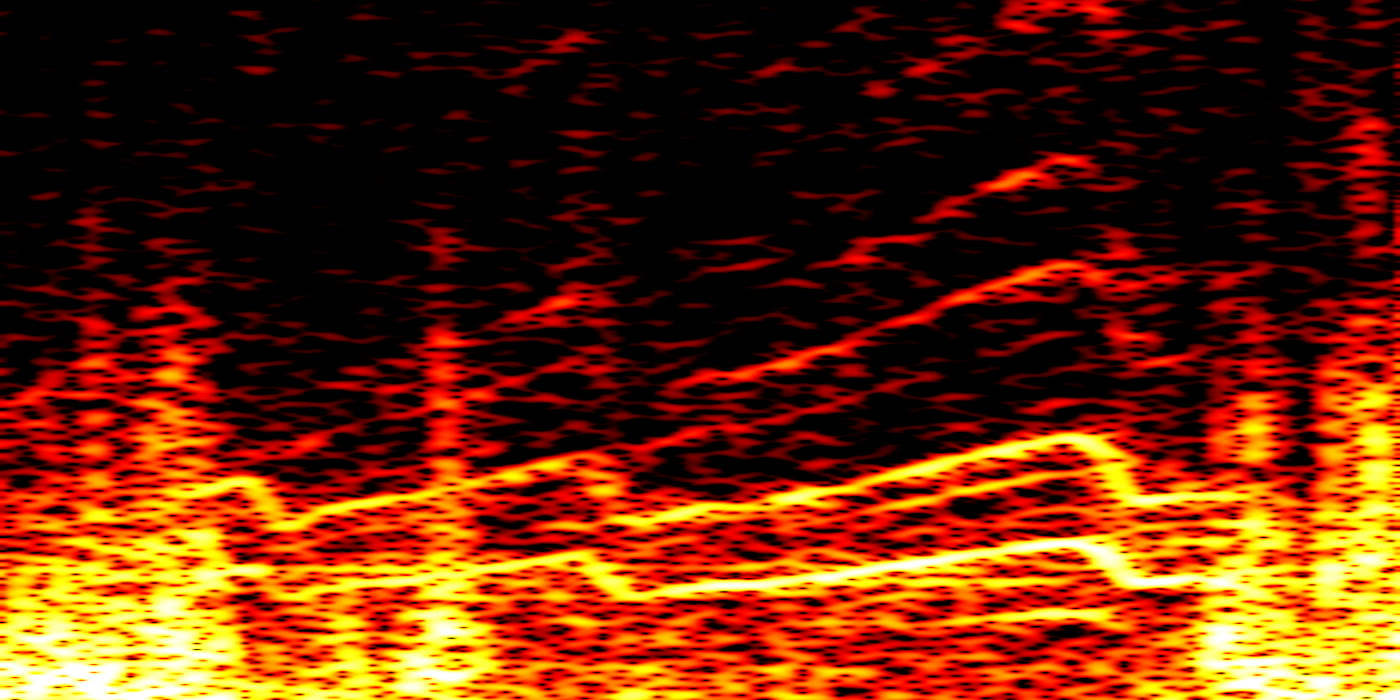
Accelerating through the gears, clip 016, 15:13:13 to 15:13:21
 60 Hz120 Hz180 Hz240 Hz300 Hz360 Hz0:160:180:200:220:240:26
Heard from the woods, not seen. The lines climb, drop at a gear change near 0:20, climb again and drop at 0:24.5. The two strongest lines keep a ratio of 1.6 to each other the whole way (73 and 118 Hz at 0:21, 92 and 146 Hz at 0:23), which fixes them as the 2.5th and 4th multiples of a crank at about 1,750 rpm, rising to 2,350 before each change.
- 1V860%
A V8 fires four times per turn, so the 4th multiple should be strong, and it is the stronger of the pair in four of five checks. The 2.5th is the uneven bank beat a V8 makes.
- 2Five cylinder25%
A five fires 2.5 times per turn, which fits the lower line, but then that line should be the stronger one.
- 3V105%
Fits the 1.6 ratio, but would mean changing gear at about 1,200 rpm, which is unlikely while accelerating.
How far to trust it
- The percentages are a judgement of how well each layout fits the lines, not measured odds.
- The method has not yet been checked against a vehicle whose engine is known. Recording one known car pulling away is the next step, and the first thing that would change these numbers.
- It says what kind of engine, never which car. A stock engine sounds like every other of its model.
- Nothing on this page shows a person or a plate.